Tilt an opal a few degrees and blue can give way to green. A ribbon of orange appears where a moment ago there was none, followed by crimson that seems to ignite somewhere beneath the surface before disappearing again. Nothing inside the gem has moved. Only the light has changed, yet the colours appear to rearrange themselves.
For thousands of years, people searched for an explanation. Roman writers believed opals gathered the beauty of every precious gem into one jewel. Arabic tradition imagined them falling from the heavens in flashes of lightning. Medieval Europe associated them with hope, prophecy and hidden sight. Long before microscopes existed, people had already noticed how difficult opal was to explain in ordinary terms.
The science is no less unusual.
The gemstone that builds rainbows
A sapphire is blue because of elements within its crystal structure. An emerald owes its green to chromium or vanadium. Opal works differently. Its colours come from the way light interacts with the structure of the material itself.
Deep inside a precious opal sit millions of microscopic silica spheres, each only a fraction of the width of a human hair. They formed as silica-rich water moved through rock and deposited silica over long periods of time. In precious opal, the spheres are arranged closely enough for light passing through them to undergo diffraction and interference, producing the phenomenon known as play-of-colour.
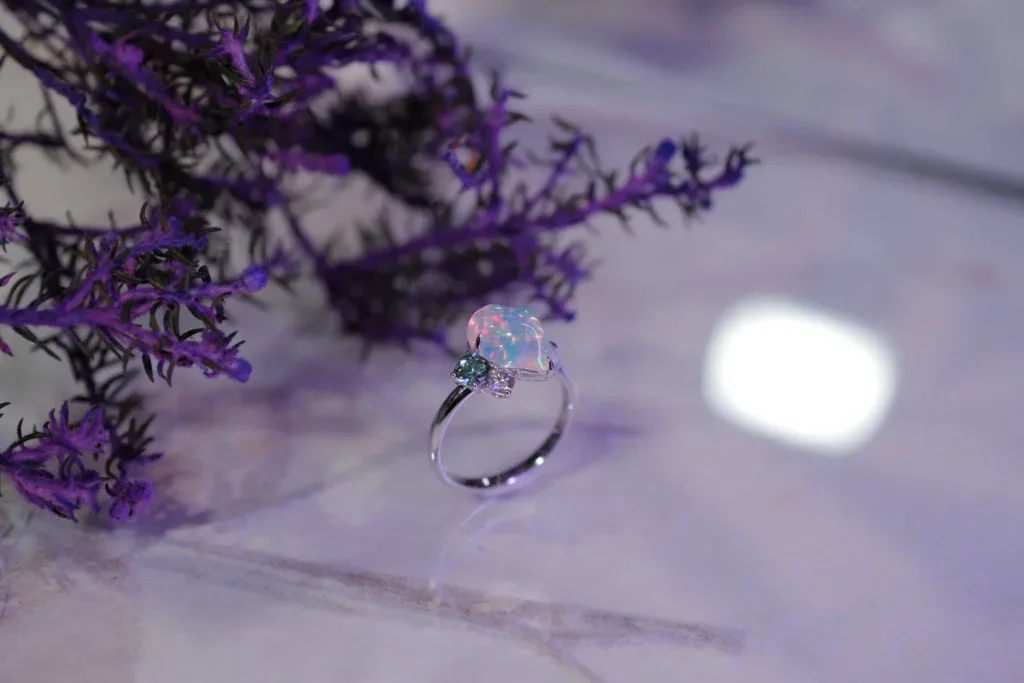
Every opal has its own pattern
Experienced jewellers rarely assess an opal by colour alone. The pattern, distribution and movement of that colour matter just as much.
Some gems produce broad flashes across much of their surface. Others show narrow bands of colour through translucent material. Certain patterns have acquired names through years of observation. Harlequin describes sharply defined patches of colour arranged across the gem. Rolling flash produces bands that appear to move as the opal is turned. Pinfire consists of numerous small points of colour scattered across the surface.
Those patterns were established as the opal formed. They cannot be added later, which is why two gems of similar size and body tone can have completely different appearances.
When jewellers examine an exceptional opal, they often turn it repeatedly, looking for how the colour behaves instead of judging it from a single position.
Australia changed the story forever
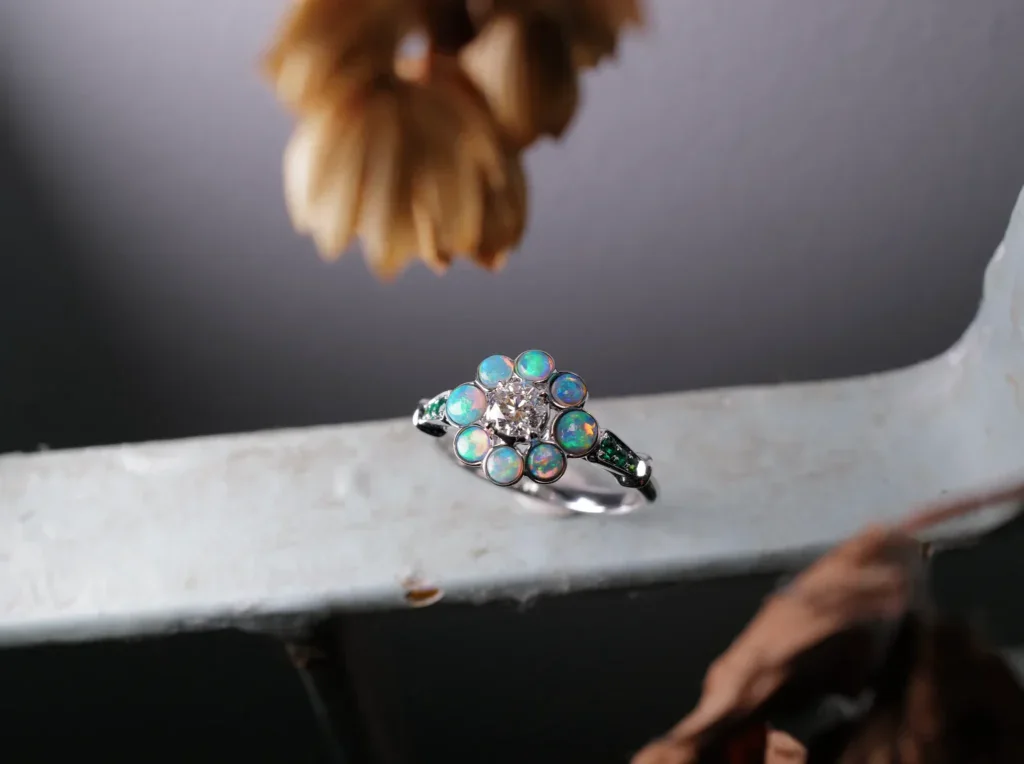
Lightning Ridge, in New South Wales, is known for black opal, whose dark body tone can provide strong contrast for blue, green and red play-of-colour. Hundreds of kilometres away, Coober Pedy became associated with white opal, with a lighter body tone that gives its colour a different appearance. The town itself is famous for its underground homes, churches and other buildings, developed partly as a response to the extreme temperatures above ground.
Queensland produces another distinctive form. Its boulder opals remain attached to the ironstone in which they formed, with seams and patches of opal running through the darker host rock.
Around 95 per cent of the world’s precious opal production comes from Australia, although the appearance of Australian opal varies considerably between mining regions. Origin can tell a jeweller something about the geological conditions in which a gem formed, but it does not by itself determine its quality.
The colour everyone waits for
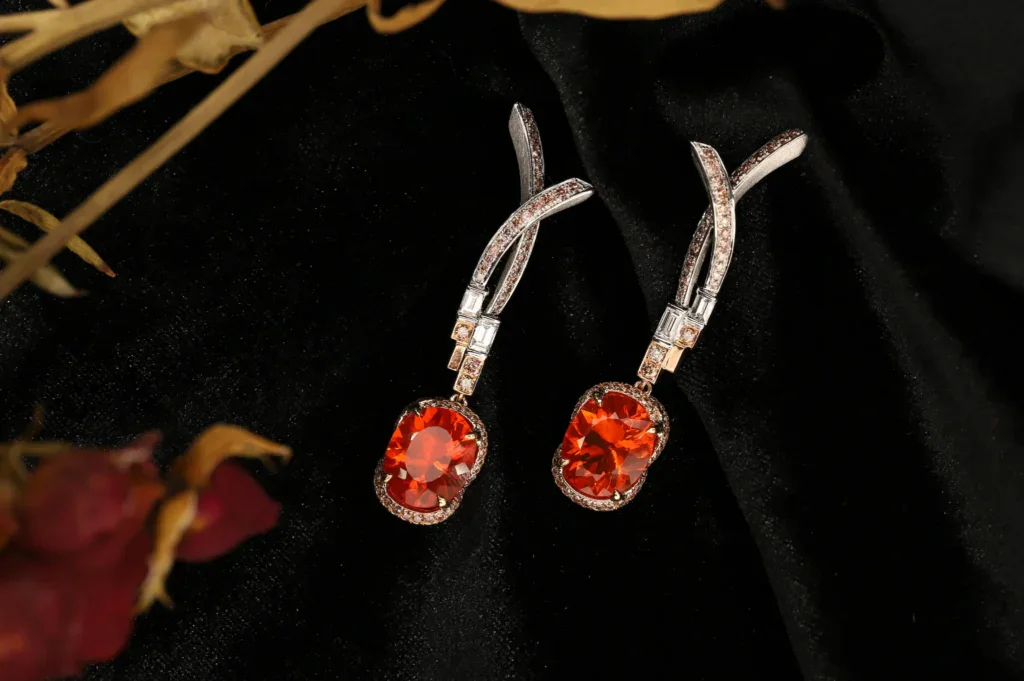
Strong red play-of-colour is relatively uncommon because it depends on the size and regularity of the silica spheres and the way their arrangement interacts with light. The effect can become especially striking when red appears across a substantial area of the gem.
Red is highly sought after, but colour is only one part of how an opal is assessed. Brightness, pattern, coverage, contrast and the quality of the play-of-colour all matter.
A black opal with broad red flashes can be dramatic. A crystal opal can show colour suspended against a transparent or translucent body. A boulder opal may have only a narrow vein of electric blue running through its ironstone and still be remarkable for the way that colour is distributed.
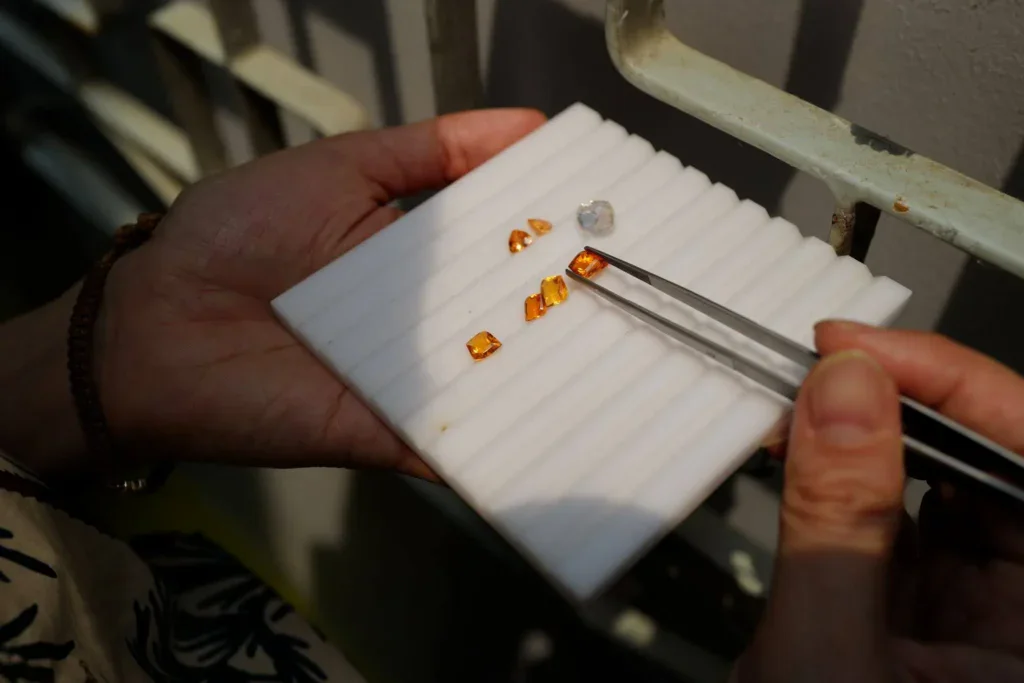
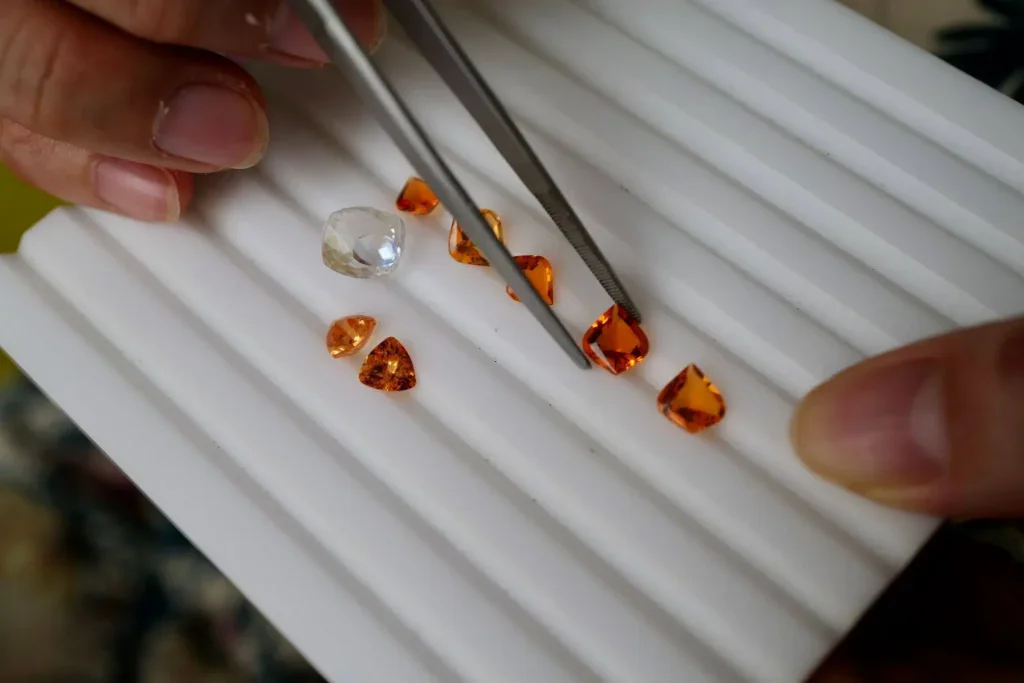
The gem that fooled an entire continent
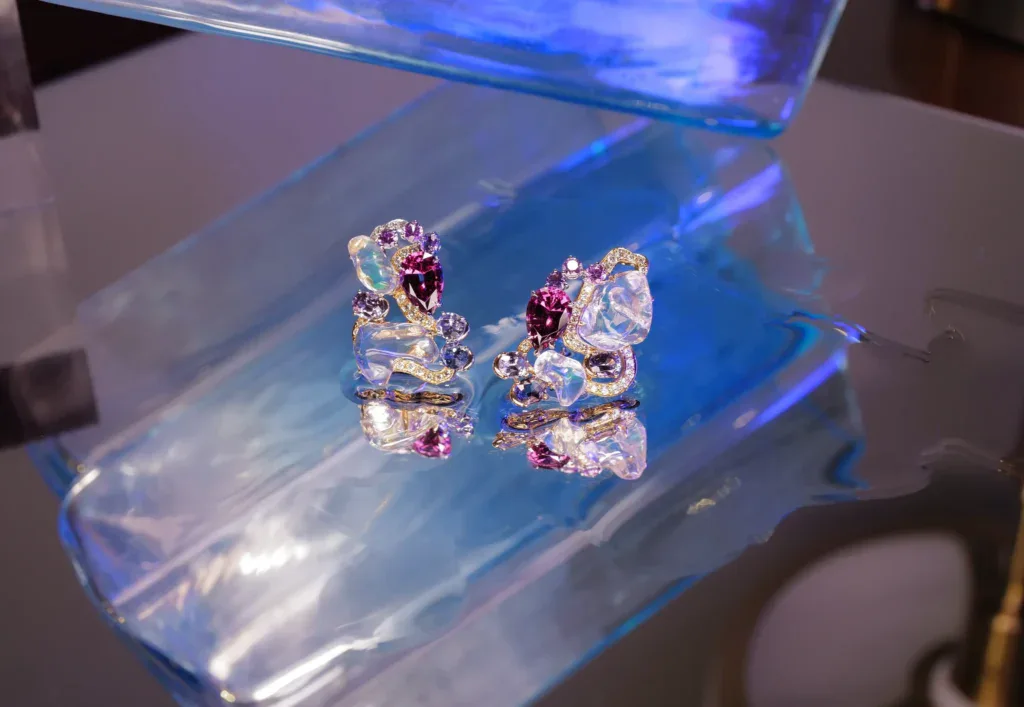
Few gemstones have had their reputation altered by a work of fiction as dramatically as opal.
For centuries, opal was regarded in Europe as a fortunate and desirable jewel. Roman writers praised it, while Queen Victoria owned and gave opal jewellery during the nineteenth century, when the gem was fashionable among European royalty.
Then Sir Walter Scott published Anne of Geierstein in 1829.
One of the novel’s characters wears a magical opal whose brilliance disappears before tragedy strikes. The story helped spread the idea that opal was unlucky, and the superstition became particularly strong in parts of Europe despite having no basis in the properties of the gem itself.
The effect on the opal trade became part of the gemstone’s history, particularly as Australian opal production expanded in the late nineteenth and early twentieth centuries.
The opal that changes with the weather
One of the oldest stories about opal has a scientific explanation behind part of it.
Some opals can change appearance when they absorb water.
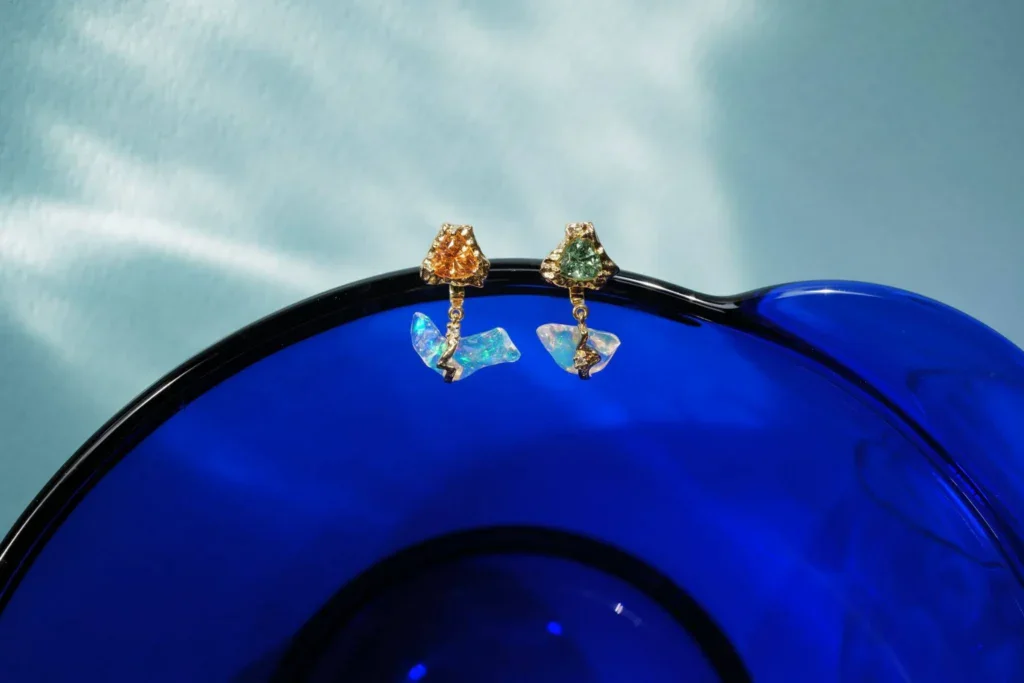
We designed these yin yang earrings around the water opals which fell along the curvature of our client’s ear perfectly. They resembled little clouds, so we added a thunderbolt fixture striking through them.
Many Ethiopian hydrophane opals contain a network of microscopic pores that allows them to take in liquids. As water enters the gem, its transparency and the appearance of its play-of-colour can change. A translucent opal may become more transparent, while its colours can soften, intensify or become temporarily less visible. As the water leaves the gem, its original appearance generally returns.
Australian opals generally have a different structure and do not behave in the same way. This is one reason the variety and origin of an opal matter when considering how it should be handled and cared for.
Water entering the porous structure of the gem alters the way light travels through it, producing the change in appearance.
The gentlest designs often require the most restraint
Opal asks for a different approach from a jeweller.
Unlike sapphire and ruby, which belong to the corundum family and rank 9 on the Mohs scale, opal is considerably softer, generally measuring around 5.5 to 6.5. It can also contain internal features and, in some varieties, a significant amount of water. Exposed edges and surfaces therefore require more care than they would in a harder gemstone.
That affects the setting as well as the way the finished piece is worn.
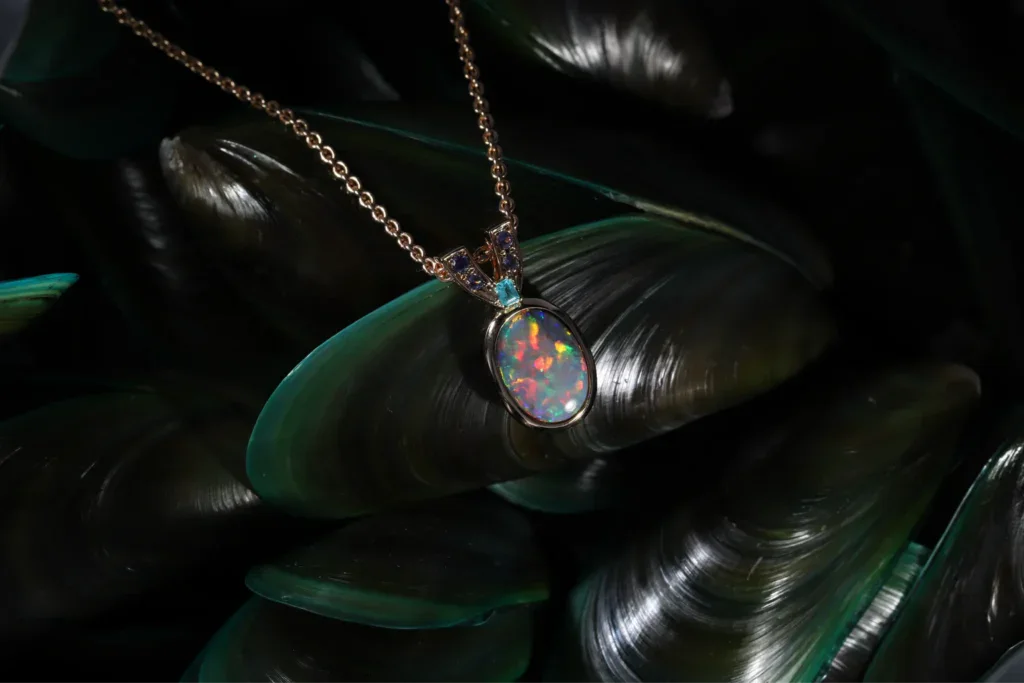
A bezel can offer protection around the edges of a cabochon without competing with the gem. Smooth cabochons are particularly common in opal jewellery because their curved surfaces allow the play-of-colour to remain visible across the gem.
At Calla Lily’s Tiong Bahru atelier in Singapore, this is where bespoke design becomes particularly interesting. An opal’s pattern, body tone and play-of-colour can influence the proportions, setting and way a finished piece is seen when it moves. The gem can become the starting point for the design itself.
The moment jewellers wait for
An exceptional opal is difficult to judge while it is sitting perfectly still. A small change in angle can reveal colours that were invisible a moment earlier, show how widely the play-of-colour extends or expose a pattern that only appears from one direction.
Some gems flash across most of their surface. Others reveal their strongest colour within a narrow range of movement.
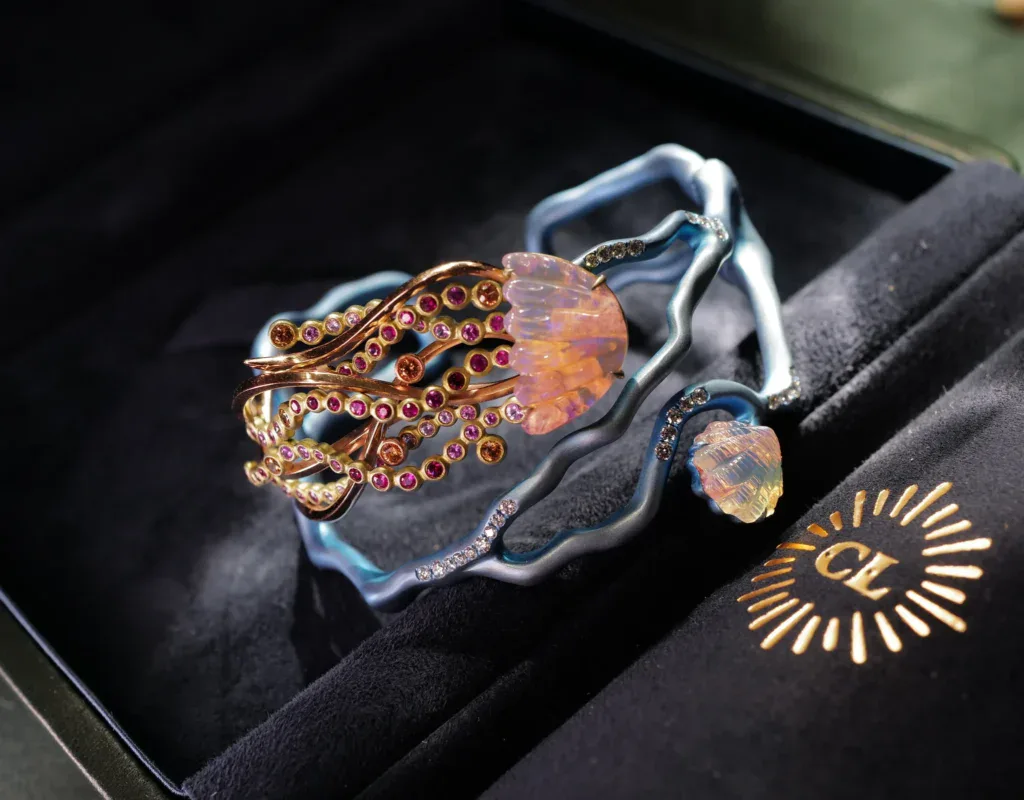
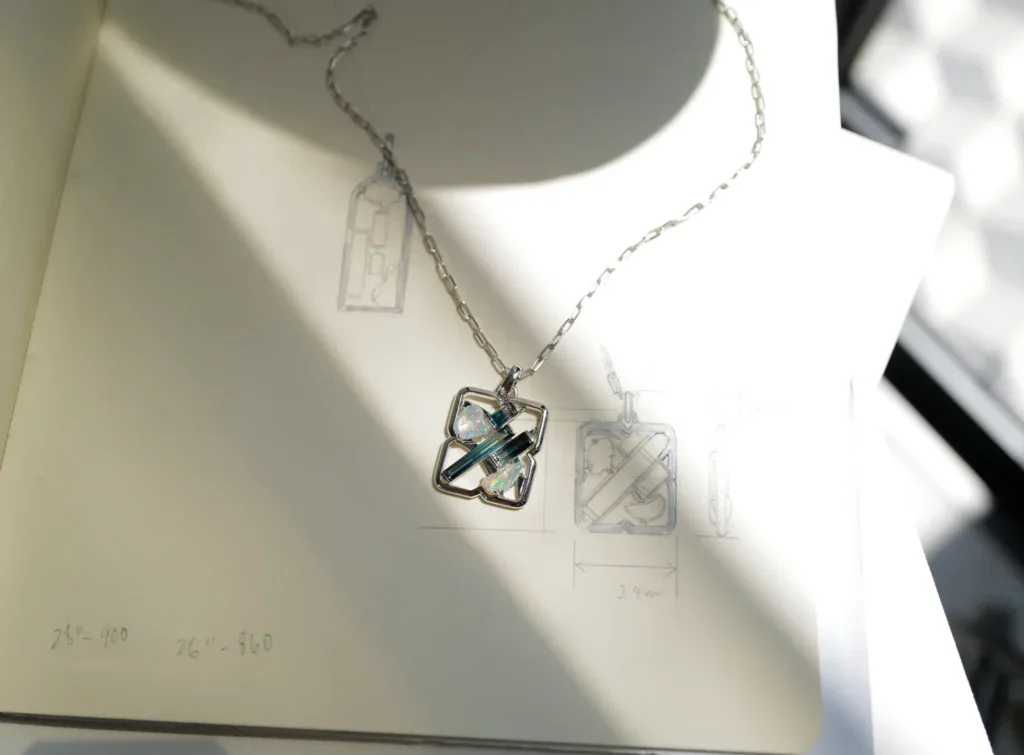
Titanium Opal Necklace from the Nature Collection
A photograph can record a particular view, but it cannot show how the gem changes as the light moves across it. For a jeweller working with opal, that movement is part of what has to be understood before the design is finished.
Earlier cultures interpreted those changing colours through mythology because they had no way of explaining the optical structure responsible for them. We can now describe the physics behind the effect. Watching it happen still requires nothing more complicated than turning the gem in the light.